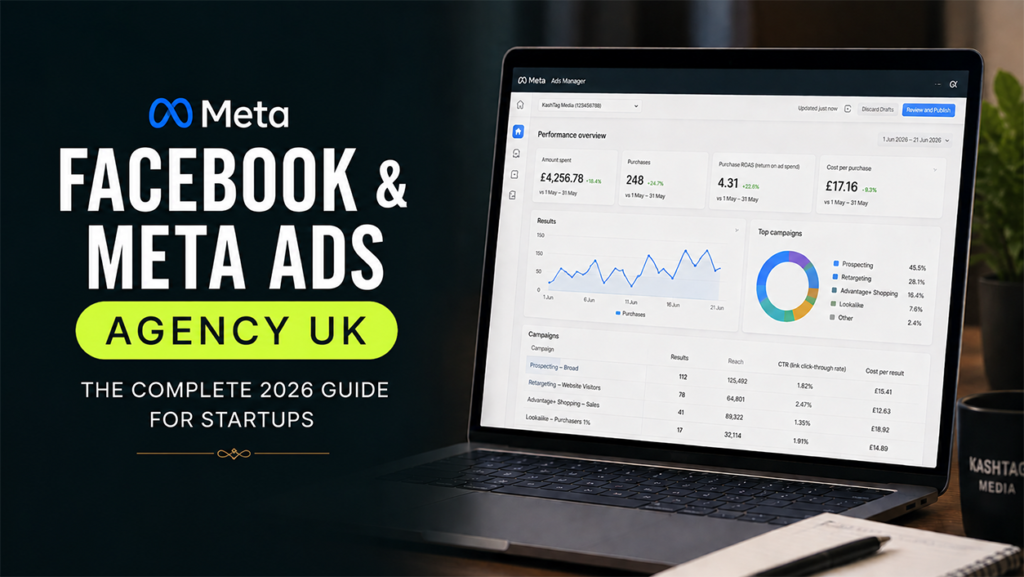
Meta Ads Agency UK searches have grown steadily as UK startups look past generic "social media marketing" and search for specialists who actually understand Facebook advertising, Instagram ads, and the Meta ecosystem at a technical level. This guide is built for exactly that audience. As a Meta Business Partner agency based in East London, we've spent several years running Facebook ads, Instagram ads, and broader Meta advertising campaigns across e-commerce, local businesses, and B2B startups — with budgets ranging from £500 a month to five-figure monthly advertising spends. Everything below reflects what we've actually seen work, not theory copied from Meta's own documentation.
In This Guide
53M+
Facebook and Instagram monthly active users in the UK combined
£0.50–£2
Typical cost per click for UK startup Meta campaigns in 2026
89%
of UK businesses use social media marketing — Meta remains #1 for paid
£1.50–£2.50
Average CPC for UK SMBs across most industries in 2026
£500/mo
Minimum ad spend to generate meaningful optimisation data
+15–30%
Higher CPCs for London campaigns vs UK average
Swipe to see more →
Why Why Meta Ads Still Matter for UK Startups in 2026
Meta Ads are paid advertisements that appear across Facebook, Instagram, Messenger, and the Audience Network. They allow UK startups to reach highly targeted audiences based on interests, demographics, behaviour, and previous interactions with their business — at a level of precision no other advertising platform currently matches at this scale.
Despite TikTok’s growth and LinkedIn’s B2B dominance, Meta’s advertising platform remains the most versatile and data-rich paid social channel available to a Facebook Ads Agency UK or Meta Ads Agency UK client base in 2026. The reason is scale combined with precision in a single platform. With over 53 million monthly active users across Facebook and Instagram in the UK, Meta reaches virtually every adult demographic, while its advertising platform lets you slice that audience by age, location, interests, life events, purchasing behaviour, and — crucially — by whether someone has already engaged with your brand.
This means two businesses in completely different industries bidding on Google Ads can have radically different costs per click — a personal injury solicitor might pay £9 per click while a craft e-commerce store pays 40p. Understanding this context is the first step to budgeting realistically.
Two Costs, Always Separate
Google Ads has two completely distinct costs that must never be bundled together.
Ad Spend
is the money paid directly to Google — you only pay when someone clicks your ad, and this money goes to Google, not your agency.
Management Fees
are what you pay the agency or specialist running your campaigns for their time, strategy, and expertise. Always insist on seeing these as two separate line items on every invoice. If an agency won't separate them, that's a serious red flag.
Meta Ads vs Google Ads: Which Should a UK Startup Choose First?
Google Ads is a demand-capture channel — it reaches people actively searching for what you sell. Meta Ads is a demand-creation channel — it introduces your brand to people who match your ideal customer profile before they search. Most UK startups benefit from using both, but if budget forces a choice, the table below outlines the trade-offs a paid social agency UK founders typically weighs.
| Factor | Meta Ads (Facebook & Instagram) | Google Ads |
|---|---|---|
| Intent type | Discovered demand — reaches people before they search | Captured demand — reaches people already searching |
| Best for | Brand awareness, consumer products, visual businesses | Service businesses, high-intent purchases, local search |
| Typical CPC (UK) | £0.50–£2.00 | £0.50–£9.00+ depending on industry |
| Time to first result | Days, but needs a learning phase to stabilise | Hours to days |
| Targeting basis | Demographics, interests, behaviour, custom/lookalike audiences | Keywords and search intent |
| Creative dependency | High — performance is creative-led | Lower — performance is keyword and landing-page led |
Intent type
Best for
Typical CPC (UK)
Time to first result
Targeting basis
Creative dependency
Swipe to see more →
These are averages across the UK. Your actual CPC will depend on your specific keywords, match types, geographic targeting, time of day, and — critically — your Quality Score. A well-optimised campaign with strong ad copy and a high-converting landing page can achieve CPCs 20–40% below these averages. A poorly structured campaign with low Quality Scores can pay significantly more than these benchmarks for the same clicks.
KashTag recommendation
For most UK startups on a limited budget, start with Google Ads for fast bottom-of-funnel results, then add Meta Ads to build awareness and retarget website visitors. Read our full breakdown in Meta Ads vs Google Ads for UK Startups and our companion piece on how much Google Ads actually costs in the UK.
Meta Ads vs TikTok Ads and LinkedIn Ads
Choosing a paid social platform isn’t binary. Each platform suits different business models, and a good Facebook Marketing Agency will usually recommend a primary and secondary channel rather than one alone.
| Platform | Strongest for | UK CPM range | Creative format |
|---|---|---|---|
| Meta (FB/IG) | E-commerce, lifestyle, broad consumer reach | £5–£15 | Photo, video, carousel, collection |
| TikTok Ads | Younger demographics, viral-style organic-feel creative | £4–£10 | Short-form vertical video only |
| LinkedIn Ads | Enterprise B2B, recruitment, high-ticket B2B services | £20–£40+ | Sponsored content, InMail, document ads |
Meta (FB/IG)
TikTok Ads
LinkedIn Ads
Swipe to see more →
Want to know exactly what Google Ads could do for your startup?
Book a free 30-minute consultation with KashTag Media. We'll review your current situation, give you a realistic budget recommendation, and tell you honestly whether Google Ads is the right first channel for your business — no pitch deck, no pressure.
Book Your Free ConsultationReal UK Meta Ads Costs in 2026: CPM, CPC, CPA and ROAS
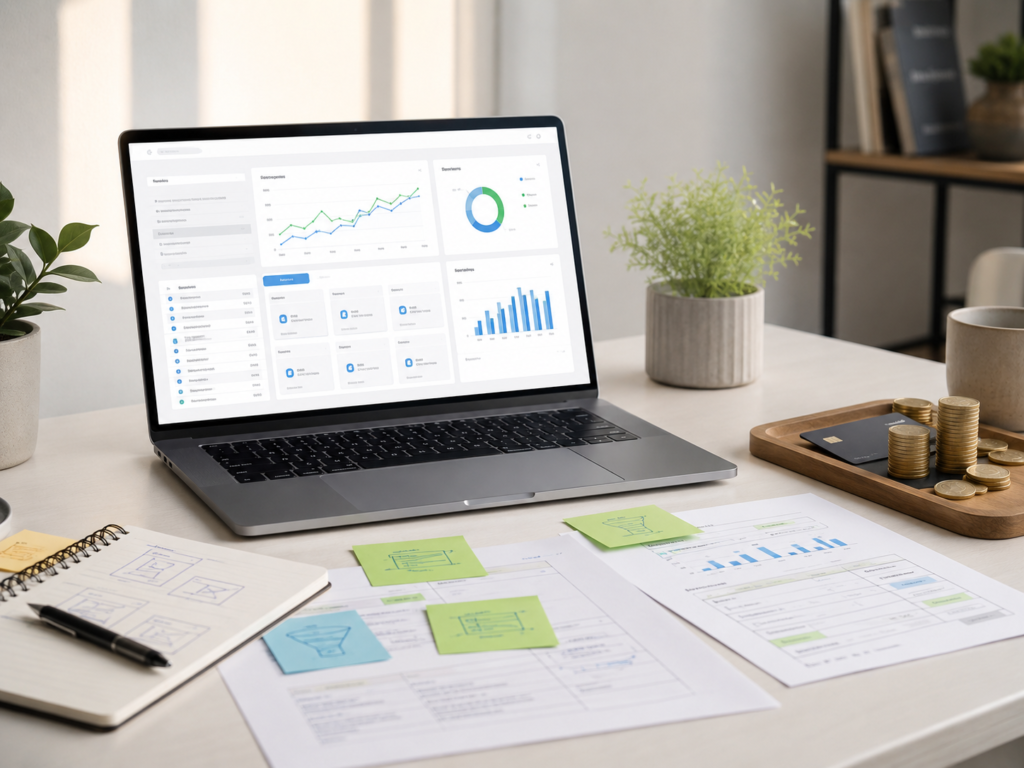
Meta advertising costs in the UK are set by a real-time auction — you bid against other advertisers for ad placements, and your cost depends on audience competitiveness, ad quality, and campaign objective. Here are the benchmarks UK startups should use for planning in 2026:
| Metric | UK average (2026) | Notes |
|---|---|---|
| Cost per 1,000 impressions (CPM) | £5–£15 | Lower for broad awareness; higher for narrow retargeting audiences |
| Cost per click (CPC) | £0.50–£2.00 | Varies significantly by industry and creative quality |
| Cost per lead (CPL) | £8–£35 | Depends on offer complexity and landing page conversion rate |
| Cost per acquisition (CPA), e-commerce | £15–£60+ | Lower for impulse buys, higher for considered purchases |
| Customer Acquisition Cost (CAC), service business | £40–£150+ | Varies hugely by service value and sales cycle length |
| Target ROAS benchmark | 3:1 to 5:1 | Healthy range for most e-commerce; varies by margin |
| Minimum recommended daily budget | £10–£20/day | Below £5/day, the algorithm can't optimise effectively |
Cost per 1,000 impressions (CPM)
Cost per click (CPC)
Cost per lead (CPL)
Cost per acquisition (CPA), e-commerce
Customer Acquisition Cost (CAC), service business
Target ROAS benchmark
Minimum recommended daily budget
Swipe to see more →
These figures are UK market averages. A well-crafted ad with a compelling offer and strong landing page can achieve CPCs and CPAs well below these benchmarks — and improving Customer Lifetime Value (CLV) relative to CAC is ultimately what determines whether a Meta Ads programme is sustainable, not the CPC in isolation.
Budget Reality Check
A realistic starting budget for a UK startup running Meta Ads is £500 to £1,000 per month in ad spend. Below £300/month, you won't generate enough data for Meta's algorithm to optimise effectively. Management fees are separate — always check your agency shows these as two distinct invoice lines.
How Meta's Ad Algorithm Actually Works
Understanding Meta’s delivery system is what separates a competent Meta Ads Agency UK from an agency that simply turns campaigns on and hopes. Every ad you run enters an internal auction every single time it’s eligible to be shown, competing against every other advertiser targeting that same person at that moment.
The Three Components of Ad Auction Value
Advertiser Bid
What you're willing to pay for your chosen optimisation event.
Estimated Action Rates
Meta's prediction of how likely this specific person is to take your desired action (click, purchase, lead).
Ad Quality and Relevance
Based on feedback signals like negative comments, video completion rates, and post-click experience.
The Three Components of Ad Auction Value
Advertiser Bid
What you're willing to pay for your chosen optimisation event.
Estimated Action Rates
Meta's prediction of how likely this specific person is to take your desired action (click, purchase, lead).
Ad Quality and Relevance
Based on feedback signals like negative comments, video completion rates, and post-click experience.
Swipe to see more →
This means a lower bid with stronger creative and higher predicted relevance can beat a higher bid with weak creative — which is precisely why creative testing (covered later in this guide) matters more on Meta than on almost any other ad platform.
The Campaign Learning Phase
Every new ad set, and every ad set that undergoes a “significant edit,” enters a Learning Phase. During this period — typically the first 50 conversion events or 7 days, whichever comes first — Meta’s delivery system is actively exploring which audiences, placements, and times of day produce your desired outcome. Performance during the Learning Phase is often inconsistent and frequently more expensive per result than it will be once the campaign exits learning. Editing a campaign mid-learning-phase resets this process, which is one of the most common reasons UK startups conclude (incorrectly) that “Meta Ads don’t work for us.”
Campaign Budget Optimization (CBO)
Campaign Budget Optimization lets Meta automatically distribute your total campaign budget across ad sets in real time, shifting spend toward whichever ad set is currently delivering the best results. For most UK startups running 2–4 ad sets, CBO outperforms manually splitting budget evenly, because the algorithm reallocates spend faster than a human reviewing weekly reports could.
The Meta Tech Stack: Pixel, Conversions API and Business Manager
Before any strategy discussion matters, the technical foundation has to be correct. This is the area where we see the most self-managed UK startup campaigns fail silently — not because the strategy was wrong, but because the tracking infrastructure was incomplete.
Meta Business Manager and Meta Business Suite
All UK business advertising should run through Meta Business Manager — never a personal ad account. Business Manager centralises your ad accounts, Pages, Pixels, and team access permissions in one place, and is a prerequisite for verification, Conversions API setup, and working with any agency without handing over personal account credentials. Meta Business Suite sits alongside it as the day-to-day content and inbox management layer for organic posting across Facebook and Instagram.
The Meta Pixel
The Meta Pixel is a small piece of code installed on your website that tracks visitor behaviour — page views, add-to-carts, purchases, sign-ups — and feeds that data back into Ads Manager. Without the Pixel, Meta can only optimise for clicks, not for the actual business outcomes you care about. Installing it correctly, before any campaign launches, is non-negotiable.
Conversions API (CAPI)
Since Apple’s iOS privacy changes restricted browser-based tracking, server-side Conversions API has become essential rather than optional. CAPI sends conversion data directly from your server (or via Shopify, WooCommerce, or WordPress integrations) to Meta, bypassing the browser-level tracking limitations that now affect a significant share of iOS traffic. Running Pixel and CAPI together — known as redundant tracking — consistently produces more accurate conversion data than either alone, which directly improves Meta’s ability to optimise your campaigns.
Meta Campaign Objectives Explained
Meta Ads Manager organises campaigns by objective, and choosing the wrong one is one of the most common and costly mistakes UK startups make. Each objective tells the delivery algorithm what outcome to optimise for, which determines who sees your ad and when.
| Campaign objective | Best used for | Startup use case |
|---|---|---|
| Awareness | Brand recognition, reach | New product launch, entering a new market |
| Traffic | Website visits, blog readers | Driving visits to a key page before conversion data exists |
| Engagement | Post likes, comments, shares | Building social proof before running conversion campaigns |
| Leads | Form submissions, calls | Service businesses, B2B startups, local businesses |
| Sales / Conversions | Purchases, sign-ups | E-commerce startups, SaaS free trials, subscriptions |
| Retargeting | Re-engaging warm audiences | Winning back website visitors who didn't convert |
Awareness
Traffic
Engagement
Leads
Sales / Conversions
Retargeting
Swipe to see more →
For most UK startups launching their first campaign, we recommend starting with the Leads objective (service businesses) or Sales / Conversions (e-commerce). These align Meta’s algorithm with your actual commercial goal from day one rather than optimising for a vanity metric.
Advantage+ & AI Driven Campaign
Meta’s Advantage+ suite represents the platform’s shift toward AI-automated campaign management, and by 2026 it has become difficult to ignore for any serious Meta advertising agency.
Advantage+ Shopping Campaigns
Automatically test creative combinations, placements, and audience segments for e-commerce advertisers, using machine learning to find converting customers without the manual audience-building process. For UK e-commerce startups with at least 50 historical purchase events, Advantage+ Shopping frequently outperforms manually structured campaigns.
Advantage+ Audience
Replaces granular manual interest targeting with a broader, AI-guided approach that still respects "audience signals" you provide — such as a Custom Audience or a few core interests — but allows the algorithm room to find converting users outside those original boundaries. A meaningful shift toward "broad with guardrails."
Should UK Startups Use Advantage+ Immediately?
Not always. Advantage+ campaigns rely on having enough historical data to learn from. A startup with zero conversion history often gets better initial results from a manually structured campaign with 2–3 test audiences, then transitions to Advantage+ once 50-plus conversion events have accumulated.
Advantage+ Shopping Campaigns
Automatically test creative combinations, placements, and audience segments for e-commerce advertisers, using machine learning to find converting customers without the manual audience-building process. For UK e-commerce startups with at least 50 historical purchase events, Advantage+ Shopping frequently outperforms manually structured campaigns.
Advantage+ Audience
Replaces granular manual interest targeting with a broader, AI-guided approach that still respects "audience signals" you provide — such as a Custom Audience or a few core interests — but allows the algorithm room to find converting users outside those original boundaries. A meaningful shift toward "broad with guardrails."
Should UK Startups Use Advantage+ Immediately?
Not always. Advantage+ campaigns rely on having enough historical data to learn from. A startup with zero conversion history often gets better initial results from a manually structured campaign with 2–3 test audiences, then transitions to Advantage+ once 50-plus conversion events have accumulated.
Swipe to see more →
Audience Targeting in Depth
Meta’s targeting capabilities are what set it apart from every other advertising platform. For UK startups, the ability to define an audience by geography, demographics, and behaviour — and layer these together — means you can reach people who precisely match your ideal customer without wasting budget on irrelevant clicks.
| Audience type | Built from | Best for |
|---|---|---|
| Core audiences | Age, gender, location, interests, behaviours | New campaigns with no existing data |
| Custom audiences | Website visitors, email lists, video viewers, app users | Retargeting people who already know your brand |
| Lookalike audiences | People who resemble your best existing customers | Scaling beyond your own customer list once you have 100+ matched users |
| Audience Signals (Advantage+) | A blend of custom data and interests fed into AI targeting | Guiding Advantage+ campaigns without fully manual targeting |
Core audiences
Custom audiences
Lookalike audiences
Audience Signals (Advantage+)
Swipe to see more →
Core audiences
Interest and demographic targeting
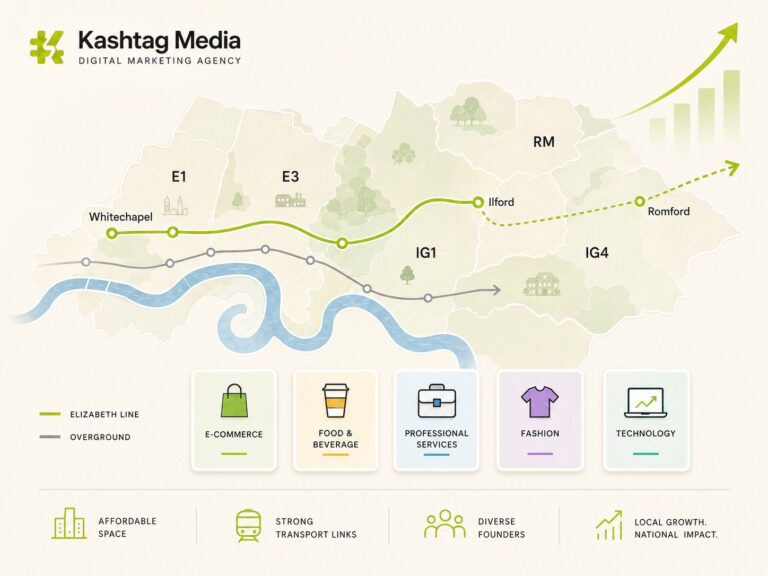
Core audience targeting lets you define who sees your ads based on age, gender, location, language, interests, and behaviours. For a startup targeting East London entrepreneurs, for example, you could target ages 25–45, within 10 miles of Ilford, interested in entrepreneurship, startups, and small business — layering interests with demographic filters to create an audience specific enough to convert but broad enough to generate meaningful data.
We typically recommend audience sizes of 150,000 to 500,000 for most UK startup campaigns.
Custom audiences
Your own first-party data
Custom audiences are built from your own data — website visitors, email subscribers, app users, or video viewers — and consistently produce the highest conversion rates on the platform because these are people who already have some relationship with your brand.
- Website custom audiences — people who visited specific pages (e.g. your pricing page or cart)
- Email list custom audiences — upload an existing customer or subscriber list to show ads specifically to those people
- Video viewer audiences — retarget people who watched 50%+ of a video, indicating genuine interest
Lookalike audiences
Scale what works
Once you have a Custom Audience of your best customers, Meta can find a "lookalike" audience — new users who share demographic and behavioural characteristics with your existing customers. UK 1% lookalike audiences typically contain 300,000–600,000 people and consistently outperform interest-based targeting once you have at least 100–1,000 matched source users.
Core audiences
Interest and demographic targeting
Core audience targeting lets you define who sees your ads based on age, gender, location, language, interests, and behaviours. For a startup targeting East London entrepreneurs, for example, you could target ages 25–45, within 10 miles of Ilford, interested in entrepreneurship, startups, and small business — layering interests with demographic filters to create an audience specific enough to convert but broad enough to generate meaningful data.
We typically recommend audience sizes of 150,000 to 500,000 for most UK startup campaigns.
Custom audiences
Your own first-party data
Custom audiences are built from your own data — website visitors, email subscribers, app users, or video viewers — and consistently produce the highest conversion rates on the platform.
- Website custom audiences — people who visited specific pages (e.g. your pricing page or cart)
- Email list custom audiences — upload an existing customer or subscriber list to show ads specifically to those people
- Video viewer audiences — retarget people who watched 50%+ of a video, indicating genuine interest
Lookalike audiences
Scale what works
Once you have a Custom Audience of your best customers, Meta can find a "lookalike" audience — new users who share demographic and behavioural characteristics with your existing customers. UK 1% lookalike audiences typically contain 300,000–600,000 people and consistently outperform interest-based targeting once you have at least 100–1,000 matched source users.
Swipe to see more →
KashTag Targeting Framework for New Startups
If you're just launching, you don't have a Custom Audience yet. Start with broad interest targeting to build Pixel data, then transition to Custom and Lookalike audiences once you've accumulated 500+ website visitors. This three-phase approach — broad, custom, lookalike — is how we structure Meta campaigns that improve every month rather than plateauing.
Ad Formats That Convert in 2026
Meta offers more than a dozen ad formats across Facebook and Instagram. For UK startups with limited creative resources, focus on the formats that consistently deliver the best results without requiring a large production budget.
| Format | Where it appears | Best use case |
|---|---|---|
| Instagram Reels Ads | Reels feed | Short, high-energy video for awareness and discovery |
| Facebook Feed Ads | Main news feed | General-purpose format for most objectives |
| Stories Ads | FB & IG Stories | Full-screen vertical creative, strong for urgency offers |
| Carousel Ads | Feed, swipeable | Multiple products or a sequential step-by-step story |
| Collection Ads | Feed, opens to Instant Experience | E-commerce catalogue browsing within the platform |
| Instant Experience | Full-screen post-click canvas | Immersive storytelling and product showcases |
| Messenger Ads | Messenger inbox & placements | Conversational lead generation and customer service |
| Video Ads | Feed, Reels, Stories | Brand storytelling, product demos |
Instagram Reels Ads
Facebook Feed Ads
Stories Ads
Carousel Ads
Collection Ads
Instant Experience
Messenger Ads
Video Ads
Swipe to see more →
Why video and Reels dominate in 2026
Short-form video is the highest-performing format across both Facebook and Instagram. You don't need a professional crew — well-lit, authentic footage shot on a smartphone consistently outperforms polished studio content in startup contexts. The first three seconds are critical: hook the viewer before they scroll past. A strong visual or a provocative question outperforms a slow brand intro almost every time.
Single image ads still earn their place
Clean, high-contrast single images with minimal text remain effective for direct response campaigns. Meta's own data shows images with less than 20% text coverage deliver better reach and lower CPMs. For UK startups, product images on white backgrounds work well for e-commerce, while lifestyle photography tends to outperform for service businesses.
Lead generation ads (Instant Forms)
Meta's native lead forms — pre-filled with a user's Facebook profile data — significantly reduce friction in the enquiry process. For service-based UK startups, Lead Ads can achieve cost-per-lead 30–50% lower than sending traffic to an external landing page, because the user never leaves the platform.
Creative Testing Framework: The Real Driver of Performance
Awareness
Best used for: Brand recognition, reach.
Startup use case: New product launch, entering a new market.
Traffic
Best used for: Website visits, blog readers.
Startup use case: Driving visits to a key page before conversion data exists.
Engagement
Best used for: Post likes, comments, shares.
Startup use case: Building social proof before running conversion campaigns.
Leads
Best used for: Form submissions, calls.
Startup use case: Service businesses, B2B startups, local businesses.
Sales / Conversions
Best used for: Purchases, sign-ups.
Startup use case: E-commerce startups, SaaS free trials, subscriptions.
Retargeting
Best used for: Re-engaging warm audiences.
Startup use case: Winning back website visitors who didn't convert.
Swipe to see more →
How to Read Ads Manager Like a Specialist
Most UK startup founders glance at Ads Manager, see the spend total, and panic or celebrate based on that single number. A Facebook Ads Management UK specialist reads the dashboard very differently. Here’s the hierarchy of metrics that actually matters, in order:
| Metric | What it tells you | When to worry |
|---|---|---|
| Cost per result (CPL/CPA) | The real commercial outcome — your north star metric | Trending upward over 2+ weeks with no creative refresh |
| ROAS | Revenue generated per £1 of ad spend | Falls below your breakeven ROAS threshold |
| CTR (Click-Through Rate) | Creative relevance and hook strength | Below 1% for feed/Reels placements consistently |
| Frequency | How many times the same person has seen your ad | Above 3–4 within a 7-day window without a sales spike |
| CPM | Auction competitiveness for your audience | Rising sharply with no change in targeting — signals fatigue or seasonality |
| Quality ranking | Meta's relative assessment of ad quality vs competitors | "Below average" rating on any dimension |
Cost per result (CPL/CPA)
ROAS
CTR (Click-Through Rate)
Frequency
CPM
Quality ranking
Swipe to see more →
CTR and CPM are diagnostic metrics — they help explain why performance is moving. CPA, ROAS, and ultimately Customer Lifetime Value relative to CAC are the metrics that determine whether the campaign is actually working for the business.
Scaling Budgets Without Breaking Performance
One of the most common questions from growing UK startups is how to scale Meta Ads spend once a campaign is profitable, without immediately seeing CPA spike. The standard guidance from experienced Meta advertisers, KashTag Media included, is:
- Increase budget in 20–30% increments, no more than once every 3–4 days, to avoid retriggering the Learning Phase unnecessarily
- Scale horizontally before scaling vertically — duplicate a winning ad set into a new audience segment rather than only increasing budget on the existing one
- Watch CPM as the early warning signal — if CPM rises sharply as budget increases, you're likely exhausting the highest-intent portion of your audience and need to broaden targeting
- Layer in Advantage+ at scale — once a campaign has substantial conversion history, transitioning budget into Advantage+ Shopping or Advantage+ Audience campaigns often unlocks further efficient scale beyond what manual audience segmentation can find
First-Party Data and Privacy Changes
Apple’s App Tracking Transparency framework and the broader move toward privacy-first browsing have permanently changed how Meta — and every other ad platform — gathers conversion data. For UK startups, the practical implications are:
- Browser-based Pixel tracking alone now under-reports conversions, particularly on iOS Safari traffic
- Server-side Conversions API (CAPI) has moved from "nice to have" to essential infrastructure
- First-party data — your own email list, CRM data, and logged-in website behaviour — is becoming more valuable than third-party targeting signals, because it's not affected by browser-level restrictions
- Building an owned email list and syncing it as a Custom Audience is one of the most resilient long-term strategies against ongoing privacy changes
This is part of why KashTag Media treats CAPI implementation as a standard, non-optional part of onboarding every new Meta Ads client — not an advanced add-on.
Launching Your First Meta Campaign: A Step-by-Step Checklist
Set up Meta Business Manager and verify your domain
All UK business advertising should run through Business Manager, not a personal account. Domain verification is required for conversion tracking and is a five-minute process via your website backend.
Install the Meta Pixel and Conversions API
The Pixel and CAPI together track visitor behaviour and power retargeting and conversion optimisation. Without them, Meta can only optimise for clicks, not sales or leads.
Define your campaign objective clearly
Match your objective to your immediate business goal. If you want enquiries, choose Leads. If you want purchases, choose Sales.
Build your audience layers
Start with a core interest audience of 150,000–500,000 people in your target location. Set up a website Custom Audience retargeting campaign to run simultaneously.
Create 3–5 ad variations for your first test
Test different hooks, images, and CTAs. Let each run at least 7 days and 1,000 impressions before judging. Don't edit within the first 48–72 hours.
Set your budget and bidding strategy
Start with a £10–£20/day campaign budget and use Lowest Cost bidding. Scale spending on winning ad sets only after identifying what converts.
Monitor, optimise, and scale systematically
Check results weekly, not daily. Focus on cost per result and ROAS, not impressions or CTR alone. Scale gradually using the framework above.
Swipe to see more →
Common Mistakes UK Startups Make With Meta Ads
Starting without the Pixel or CAPI installed
Launching campaigns before installing tracking infrastructure is the single most common and costly mistake. Without it, Meta cannot optimise for conversions and you cannot retarget website visitors or build Lookalike Audiences. Install Pixel and CAPI before day one.
Too-small audiences and overly tight targeting
Audiences below 50,000 starve Meta's algorithm of the data it needs. In the UK, an audience of 150,000–400,000 almost always outperforms hyper-targeted audiences of 20,000–40,000 at the same budget level.
Editing campaigns during the Learning Phase
Every significant edit to an ad set resets the Learning Phase, forcing Meta to re-accumulate the first 50 conversion events before stabilising. For small budgets, one impatient edit can cost a week of wasted optimisation.
Using the Traffic objective instead of Leads or Sales
Traffic campaigns are cheaper per click, which looks good on a report, but Meta optimises for whoever is most likely to click — not whoever is most likely to buy. Always match your objective to your actual commercial goal.
Boosting posts instead of running proper campaigns
Boosting a post uses a simplified version of Meta's ad system with limited targeting, objective, and optimisation options. Running campaigns through Ads Manager unlocks Custom Audiences, Lookalike Audiences, Advantage+, and proper conversion tracking.
Running a single ad creative with no testing
Meta's algorithm finds the best-performing ad from a selection — give it only one and there's nothing to optimise against. Always launch with at least three variations, then cut underperformers and double down on winners.
Swipe to see more →
Real result
A KashTag Media e-commerce client came to us with Meta campaigns running at a cost-per-acquisition four times their target. We rebuilt the campaign structure with three audience tiers (interest-based, website Custom Audience, Lookalike), tested five creative variations, implemented full Pixel and CAPI tracking, and switched from Traffic to Sales objective. Within 60 days, cost per acquisition dropped by 63% and monthly revenue from Meta Ads doubled.
What a Meta Business Partner Agency Actually Does Differently
The phrase “Meta verified” or “Meta Business Partner” appears on a lot of agency websites. Here’s what it actually means in practice, and why it matters when you’re trusting someone else with your ad budget.
Meta Business Partners have met Meta's requirements for advertising expertise, account security, data privacy compliance, and client result standards. In practice, this means KashTag Media — as a verified Meta Business Partner — has access to:
- Direct Meta support — when an issue arises with an account, we have access to Meta's business support team, resolving problems in hours rather than days
- Early access to features — including newer Advantage+ capabilities, sometimes made available to verified partners before general release
- Conversion API implementation support — server-side tracking that captures conversion data even when browser-based Pixel tracking is blocked by iOS privacy settings
- Business verification — adding an additional layer of account security and reducing the risk of ad account suspension
Facebook Ads Agency vs Freelancer: Which Should You Choose?
| Format | Where it appears | Best use case |
|---|---|---|
| Instagram Reels Ads | Reels feed | Short, high-energy video for awareness and discovery |
| Facebook Feed Ads | Main news feed | General-purpose format for most objectives |
| Stories Ads | FB & IG Stories | Full-screen vertical creative, strong for urgency offers |
| Carousel Ads | Feed, swipeable | Multiple products or a sequential step-by-step story |
| Collection Ads | Feed, opens to Instant Experience | E-commerce catalogue browsing within the platform |
| Instant Experience | Full-screen post-click canvas | Immersive storytelling and product showcases |
| Messenger Ads | Messenger inbox & placements | Conversational lead generation and customer service |
| Video Ads | Feed, Reels, Stories | Brand storytelling, product demos |
Instagram Reels Ads
Facebook Feed Ads
Stories Ads
Carousel Ads
Collection Ads
Instant Experience
Messenger Ads
Video Ads
Swipe to see more →
Why video and Reels dominate in 2026
Short-form video is the highest-performing format across both Facebook and Instagram. You don't need a professional crew — well-lit, authentic footage shot on a smartphone consistently outperforms polished studio content in startup contexts. The first three seconds are critical: hook the viewer before they scroll past. A strong visual or a provocative question outperforms a slow brand intro almost every time.
Single image ads still earn their place
Clean, high-contrast single images with minimal text remain effective for direct response campaigns. Meta's own data shows images with less than 20% text coverage deliver better reach and lower CPMs. For UK startups, product images on white backgrounds work well for e-commerce, while lifestyle photography tends to outperform for service businesses.
Lead generation ads (Instant Forms)
Meta's native lead forms — pre-filled with a user's Facebook profile data — significantly reduce friction in the enquiry process. For service-based UK startups, Lead Ads can achieve cost-per-lead 30–50% lower than sending traffic to an external landing page, because the user never leaves the platform.
What Meta Ads Performance Actually Looks Like by Sector
Generic benchmarks are useful for initial planning, but UK startups consistently ask a more specific question: what does good performance actually look like in my industry? Based on KashTag Media’s account management across multiple verticals, here’s a realistic sector-level view.
| Format | Where it appears | Best use case |
|---|---|---|
| Instagram Reels Ads | Reels feed | Short, high-energy video for awareness and discovery |
| Facebook Feed Ads | Main news feed | General-purpose format for most objectives |
| Stories Ads | FB & IG Stories | Full-screen vertical creative, strong for urgency offers |
| Carousel Ads | Feed, swipeable | Multiple products or a sequential step-by-step story |
| Collection Ads | Feed, opens to Instant Experience | E-commerce catalogue browsing within the platform |
| Instant Experience | Full-screen post-click canvas | Immersive storytelling and product showcases |
| Messenger Ads | Messenger inbox & placements | Conversational lead generation and customer service |
| Video Ads | Feed, Reels, Stories | Brand storytelling, product demos |
Instagram Reels Ads
Facebook Feed Ads
Stories Ads
Carousel Ads
Collection Ads
Instant Experience
Messenger Ads
Video Ads
Swipe to see more →
E-commerce and direct-to-consumer brands
E-commerce startups typically see the fastest path to profitability on Meta because the platform's Catalogue and Advantage+ Shopping tools were purpose-built for product-based businesses. A new D2C brand with a £1,500/month ad spend can realistically expect to reach a 3:1 to 4:1 ROAS within 60–90 days once Pixel and CAPI data has accumulated, assuming a competitive product and a conversion-optimised product page. Carousel and Collection ad formats consistently outperform single image ads for multi-SKU catalogues.
Local service businesses
Local service businesses — tradespeople, clinics, salons, fitness studios — benefit most from Lead Generation campaigns combined with tight geographic radius targeting. Because the customer base is inherently local, broad audience targeting wastes a meaningful share of budget on people who will never convert. A 5–10 mile radius around the business location, layered with relevant interest targeting, typically produces the strongest cost-per-lead outcomes for this sector.
B2B and SaaS startups
B2B and SaaS startups face a longer consideration cycle, which means a single-touch Sales campaign rarely performs as well as a sequenced approach: an Awareness or Engagement campaign to build initial familiarity, followed by a Retargeting campaign with a stronger offer (case study download, free trial, demo booking) for people who've already engaged. Patience matters more here than in e-commerce — judging a B2B Meta campaign after only two weeks routinely produces a false negative conclusion.
Have a Project in mind?
Book a call with our Team
Let us address your questions today!
Frequently Asked Questions
UK Meta ads typically cost £0.50 to £2.00 per click for most startup industries, with CPMs of £5 to £15. A realistic starter budget is £500 to £1,000 per month in ad spend, plus agency management fees of £500 to £1,500 per month. KashTag Media's starter packages begin at £500/month and always show ad spend and management fees separately.
A Meta Business Partner has passed Meta's requirements for advertising expertise, data privacy compliance, and performance standards. Verified agencies like KashTag Media gain direct Meta support, early feature access, server-side Conversions API tools, and enhanced account security.
Google Ads delivers faster bottom-of-funnel results by capturing existing search demand. Meta Ads builds demand by reaching people who match your ideal customer profile before they search. Both together produce the strongest outcomes; prioritise Google Ads first for service businesses, Meta Ads first for consumer product launches.
Yes, particularly for consumer-facing and e-commerce startups. With over 53 million UK monthly active users and sophisticated Advantage+ and Lookalike targeting, Meta remains one of the most cost-efficient channels for both awareness and direct response.
E-commerce, fashion, beauty, food and beverage, fitness, and local services consistently perform well due to strong visual creative opportunities. SME-focused B2B startups can also succeed when targeting small business decision-makers rather than enterprise buyers.
es. Native Lead Generation ads and Instant Forms let businesses collect enquiries directly within Facebook or Instagram without an external website. However, a website with the Meta Pixel installed unlocks far stronger optimisation and retargeting.
A realistic minimum is £500 to £1,000 per month in ad spend. Below £300/month, Meta's algorithm struggles to gather enough data to optimise effectively.
No. Boosting posts uses a simplified ad system with limited targeting and optimisation options. Running campaigns through Ads Manager unlocks Custom Audiences, Lookalike Audiences, Advantage+, and proper conversion tracking — all of which outperform boosted posts.
Advantage+ is Meta's AI-driven campaign automation suite, including Advantage+ Shopping and Advantage+ Audience. For startups with at least 50 conversion events of history, Advantage+ campaigns frequently outperform manually structured campaigns.
Yes, particularly for SME-focused B2B. Meta's demographic and job-related targeting can effectively reach small business owners and managers, and Lead Generation ads with instant forms work well for capturing B2B enquiries with minimal friction.
The Meta Pixel is a tracking code installed on your website that records visitor behaviour and feeds it back to Meta's ad platform. It's essential for conversion tracking, retargeting, and building Lookalike Audiences.
Most campaigns enter a Learning Phase for the first 7–14 days, during which performance can be inconsistent. After that, campaigns typically stabilise and improve over the following 60–90 days.
Written by KashTag Media
Meta Business Partner · Google Partner · Shopify Partner · Certified Google Ads Specialists. Based in East London, helping UK startups scale through paid advertising — across e-commerce, local businesses, and B2B accounts from £500 monthly budgets to five-figure monthly spends.
Ready to work with a Meta Ads Agency UK startups actually trust?
KashTag Media is a Meta Business Partner based in East London. We'll audit your current Meta setup for free and show you exactly where your budget is being wasted.
Book Your Free Meta Ads Audit